
Sabine Parish Weekly Arrest Reports
The clearest multi-day example is a weekly Sabine Index issue with an “Arrest Reports” section. The paper says the list covers arrests made in Sabine Parish during the prior week. Its source is the Sheriff’s operations center. That origin helps, but the newspaper is still the publisher. It is not the Sabine Parish Jail roster. It cannot show who remains in custody. The weekly span is what makes the format worth checking. Arrests from several dates sit together. Weekend activity becomes one readable period. The Sheriff publishes no complete public archive with a fixed start date, so a preserved PDF shows the format rather than a promise that every week stays online.
Note: Treat the date beside each entry as the event clue and the issue date as the publication context.
Read Sabine Parish Arrest Blotters
Start from the date range, not the latest headline. Media entries can outlast a live roster line. The Sheriff’s booking summary stays the official intake record, so keep those layers separate.
- Open the cited Sabine Index issue and locate the Arrest Reports section for its stated prior-week span.
- Match the entry date, name, age, charge wording, and arresting agency. Do not assume every abbreviation without source context.
- Compare current custody through the Sheriff or LA VINE roster only when present status matters.
- Check the Sabine Parish Journal for a dated Sheriff release when the event involved a periodic felony, narcotics, or firearm roundup.
- For missing dates, ask the Sheriff for the booking book, booking summary, or arrest report within a narrow range.
For the newest prior-day arrests, use Sabine Parish Arrested Today. A same-day item may overlap with the weekly blotter. Keep each list separate.
Sabine Parish Arrest Report Fields
The weekly format carries a compact set of facts. The facts come from the Sheriff’s operations center. Louisiana law describes a fuller booking summary than this list provides, so read each field for what it says.
| Weekly field | How to interpret it |
|---|---|
| Date | The arrest date printed with the entry, separate from the newspaper issue date. |
| Name | The reported identity; official spelling should be confirmed with the record custodian. |
| Age | A matching detail at the time of the report. |
| Charge or charges | Charges recorded at booking, not a plea, verdict, or sentence. |
| Arresting agency | The parish or municipal department credited for the arrest. |
| Photograph | No verified multi-day Sabine booking-photo gallery was found in the weekly source. |
A Sheriff release in the Sabine Parish Journal may add bond, release, or transfer facts. Bond is a release mechanism. Transfer marks a change in custody. Those details track how an arrested person moves through the jail.
Sabine Arrest Media Handoff
Sabine’s blotter coverage runs on a media handoff. Sabine News Now republishes Sheriff-sourced reports. These cover roughly the prior 24 hours. The Index weekly list cites the Sheriff’s operations center. The Sabine Parish Journal runs periodic Sheriff releases plus historical detention-center booking material. Each outlet sets its own cadence. The dated Sabine News Now report example shows the field presentation one current outlet uses.

A dated news report is a publication example. It is not a booking photograph. The split matters when lists disagree. A weekly entry may stay online after the roster changes, while a roster result may never become a news story. Neither source is false; they answer different questions under different systems.
Sabine Parish News Report Limits
Local news holds real historical value. Its coverage is selective, though. The Sabine Parish Journal has carried “Recent Bookings at Sabine Parish Detention Center” items. It also runs event-driven Sheriff releases. Its cadence is not a guaranteed schedule. Articles may run daily, weekly, or only when news breaks. Images can be editorial rather than official. Treat a picture as a booking photograph only when the caption names its source. The Sabine Index PDF remains the clearest weekly source for the parish. No stable archive route exists for it. Cloud files move, access shifts, and a paper may skip a period. Note the issue date, the range the report claims, and the office named as source. Aggregator sites copy entries that can sit stale. Let official Sheriff records and court files settle conflicts.
Archive Sabine Parish Arrest Records
Louisiana R.S. 44:36 sets a three-year preservation baseline when no other period applies. Exceptions apply under R.S. 44:411. Retention is not display. A three-year rule does not keep a web roster searchable for three years. No Sabine Sheriff schedule covers booking photos or jail records. The Louisiana State Archives retention-schedules page explains how schedules work for paper and electronic records.
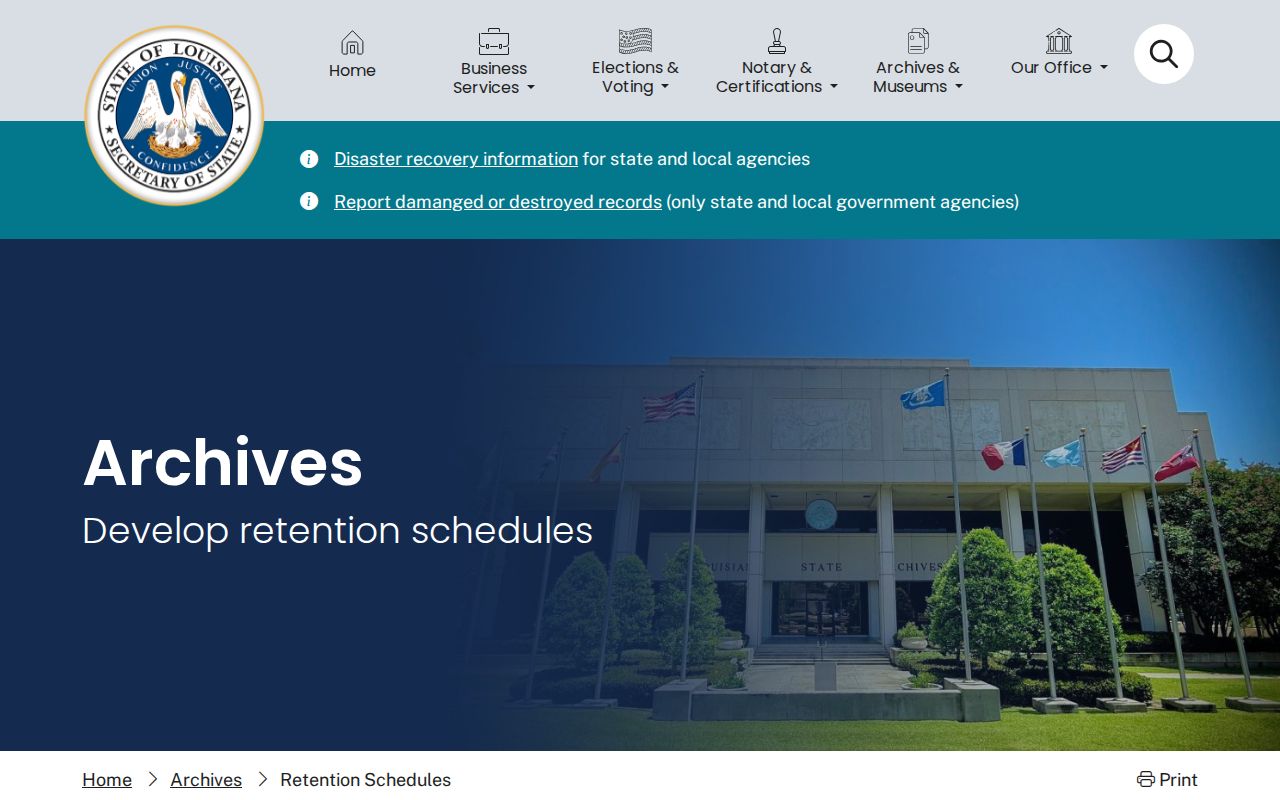
The State Archives page explains a process. It does not prove the Archives holds Sabine Parish booking records. Ask the Sheriff for the approved schedule. Booking books, summaries, jail-management data, arrest reports, and photographs each need their exact record-series title, so ask about holds, transfers, and authorized disposal too. A retained item can still be exempt from release. A public summary may also survive after its online entry rolls off.
Note: The state corrections retention rule applies after entry into DPS&C custody, not to every Sabine Parish jail booking.
Request Older Sabine Arrest Reports
Start with the Sabine Parish Sheriff's Office, which runs the local booking system. Give the exact name as printed. Add an arrest date and the agency if known. Keep the date range tight. Request the booking book, the summary, and any non-exempt report portion. Want a booking photograph? Louisiana Article 234 controls that access separately, and the public Sabine roster displays no photo field.
Older court history follows a different trail. The Sabine Parish Clerk and the 11th Judicial District Court hold bills of information, minutes, judgments, and disposition. The Clerk's online index needs a login or subscription, so it is not a free live arrest feed. Did the person later enter state custody? LA VINE or the Louisiana Department of Public Safety & Corrections covers that piece. Never treat state prison custody as the parish jail roster.
- Keep the source’s publication date and stated coverage period.
- Ask the Sheriff which retention schedule and series apply.
- Request the non-exempt portion if part of a file is withheld.
- Use the Clerk or court for the final case result.
- Preserve any written denial, transfer, or disposal explanation.
Older arrest reports for Sabine Parish sit with the records divisions that keep them. Contact the Sabine Parish Sheriff's Office to ask about past bookings and arrest records.
Sabine Parish Archive Boundaries
One arrest can leave traces in three archives. A newspaper may keep the arrest report as published, while the Sheriff retains the booking book, the summary, and the jail-management record under its approved schedule. The Clerk and court hold the criminal case that followed. None replaces the others. No digitized Sabine booking-photo archive exists.
Begin with the agency that created the record. Was a series transferred or destroyed? Ask for the schedule title, transfer details, or disposal authority. Louisiana State Archives manages schedules and can point to a records-management path, though records stored at the Records Center still belong to the depositing agency. Restricted material stays restricted after transfer.
Newspaper preservation has its own limit. An old PDF shows exactly what readers saw that issue. Yet it may skip an arrest, keep an early charge, or miss the later disposition. Note the source and date before comparing it with court minutes or a judgment. That approach keeps the blotter useful without turning an editorial archive into a custody database.
Public Record Search
Sponsored Results